And No, You Are Not the Exception.
Last month, I crossed path with a friend on the walking track and our discussions moved quickly from family, old times to AI.
The conversation ended.
But something kept bothering me for weeks.
“What are we do to if AI becomes so advanced that everything that I currently do at my work will be replaced by an AI?”
In this post, I will try to gather my thoughts on AI:
My main thoughts:
- Why no one is safe from AI (including you)
- The 10 jobs that will vanish in the next 5 to 10 years
- What Elon Musk, Jeff Bezos, and Jensen Huang are actually saying about AI
- How this changes investing forever
- The one thing you can do right now to survive and thrive.
You think AI is coming for factory workers.
You think it is coming for call center employees.
You think it is coming for data entry clerks.
You are right about all three.
But here is what nobody is telling you:
It is coming for YOU too.
The accountant. The lawyer. The junior developer. The financial analyst. The marketing manager. The radiologist reading scans.
AI does not care about your degree. It does not care about your 15 years of experience. It does not care that you are “good at your job.”
It only cares about one thing: Can it do your job cheaper, faster, and without asking for a raise?
For millions of roles, the answer is YES.
Let me explain.
The Uncomfortable Truth Nobody Wants to Hear
The World Economic Forum published its Future of Jobs Report in 2025. They surveyed over 1,000 companies representing 14 million workers across 55 countries.
The headline number: 92 million jobs will be displaced by 2030.
But wait.
They also said 170 million new jobs will be created. A net gain of 78 million.
Sounds great on paper.
Here is the problem nobody talks about.
The jobs being destroyed and the jobs being created are NOT the same jobs. They don’t need the same skills. They don’t pay the same wages. They are not in the same cities or countries.
An office worker in Dubai whose role gets automated does not become an AI prompt engineer overnight. A junior accountant in Dubai does not wake up as a machine learning specialist.
The gap between the job that disappears and the job that appears is where real human suffering lives.
Goldman Sachs estimates 25% of all global work hours could be automated by AI. McKinsey says the number is closer to 57% in the US alone if you count task level automation.
That is not a future problem. That is a right now problem.
In the first six months of 2025 alone, 77,999 tech jobs were cut and directly linked to AI driven layoffs. Wall Street banks are planning to remove 200,000 jobs over the next 3 to 5 years, mostly entry level and back office roles.
And here is the angle nobody is covering:
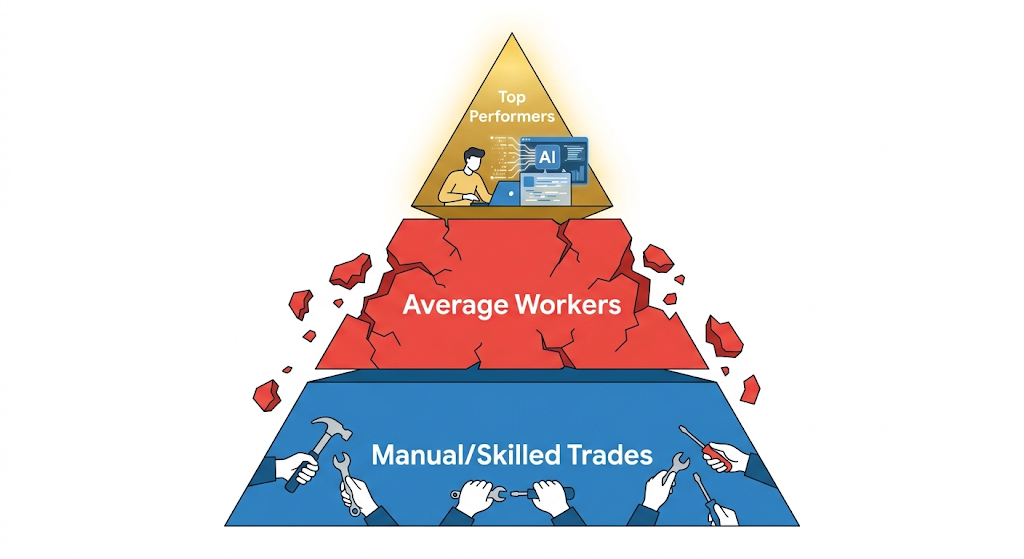
AI will not replace jobs. It will hollow out the middle of every profession.
The top 10% of performers in any field will use AI as leverage. They will become 10x more productive and earn more than ever.
The bottom tier, the manual laborers, the plumbers, the electricians, the people who work with their hands, will be fine. Robots cannot rewire your house. Not yet.
But the middle? The average knowledge worker who shows up, does acceptable work, and collects a paycheck?
That person is in serious trouble.
AI does not need to be perfect. It just needs to be cheaper than average. And it already is.
10 Jobs That I Feel Will Disappear in the Next 5 to 10 Years
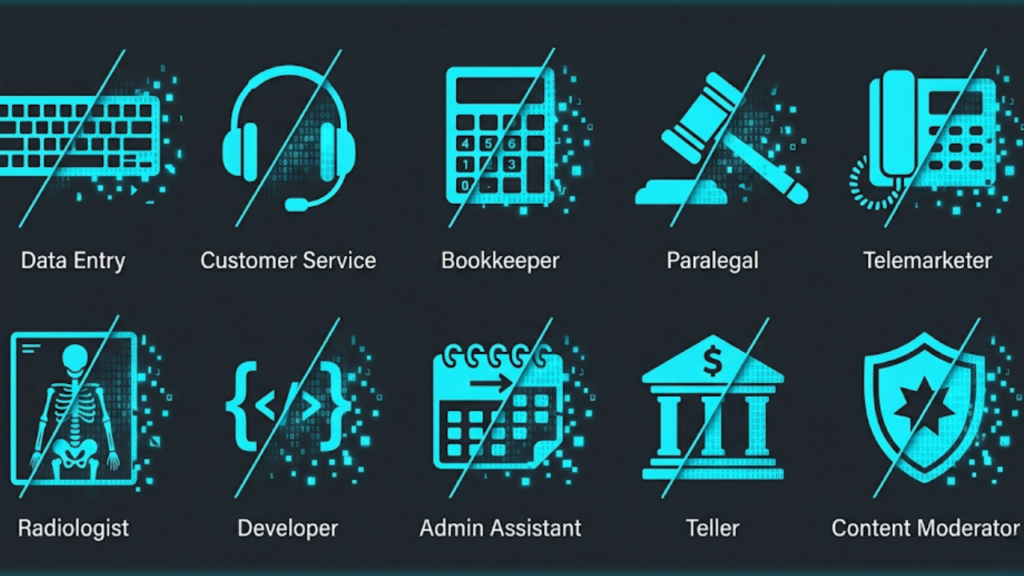
This is not fear mongering. This is pattern recognition.
1. Data Entry Clerks Pure mechanical work. AI already does this faster and with fewer errors. An estimated 7.5 million jobs at risk globally by 2027.
2. Customer Service Representatives (Basic Tier) Chatbots and virtual assistants handle most routine queries today. The human agent becomes the exception, not the rule.
3. Bookkeepers and Basic Accounting Staff If your job is recording transactions and reconciling spreadsheets, AI tools already do this in minutes.
4. Paralegals and Legal Researchers AI can review contracts, flag risks, and summarize case law faster than a team of junior associates. Law firms are already cutting entry level positions.
5. Telemarketers and Cold Callers AI voice agents are already making outbound calls that sound human. This role is being automated at scale.
6. Radiologists and Medical Image Analysts AI reads scans with accuracy that matches or exceeds trained specialists. The human still supervises, but you need far fewer of them.
7. Junior Software Developers Employment among 22 to 25 year old developers fell 20% between late 2022 and mid 2025. AI writes boilerplate code. Entry level coding jobs are shrinking fast.
8. Administrative Assistants Scheduling meetings, managing calendars, triaging emails. AI does all of this now. One executive with AI tools can replace an entire support team.
9. Bank Tellers and Loan Officers (Entry Level) Banks are investing heavily in AI for customer interaction, loan processing, and compliance. The branch model is dying.
10. Content Moderators Social media platforms are replacing human moderators with AI systems. The volume is too large for humans, and AI scales infinitely.
Now consider this.
If your job involves processing information, following rules, or producing repetitive output, you are on the list.
Maybe not today.
Maybe not next year.
But within this decade.
What the Billionaires Are Saying (Pay Attention)
The people building AI are telling you what is coming. You should listen.
Elon Musk declared at Davos in January 2026 that AI will surpass human intelligence by the end of this year. He said working at all will be optional within 20 years. He also said AI could be far more dangerous than nuclear weapons if not controlled properly.
He posted on X in early January:
“We have entered the Singularity. 2026 is the year of the Singularity.”
Musk is not a neutral observer. He runs xAI, Tesla’s Full Self Driving program, and Neuralink.
He is building the future and he is warning you about. But his core message is clear: this is not a drill.
Jeff Bezos launched Project Prometheus in November 2025, his first hands on CEO role since stepping down from Amazon. The startup raised $6.2 billion. It focuses on bringing AI into manufacturing, aerospace, and physical systems.
At Italian Tech Week 2025, Bezos said he has never been more optimistic. He predicted millions of people will live in space within two decades and robots will commute to work on our behalf.
He also called AI an “industrial bubble” but said these bubbles are good because when the dust settles, society benefits from the inventions that survive.
Jensen Huang, CEO of NVIDIA, painted a picture at a Stanford event: a future where every company has 100 AI agents for every human worker. 7.5 million AI agents alongside 75,000 humans.
He said AI agents will not replace you. They will “harass you and micromanage you.” You will be busier than ever, managing a fleet of digital workers.
His company is now worth over $4.8 trillion. The demand for computing power, in his words, is “higher than incredibly high.”
Sam Altman, CEO of OpenAI, has openly said that AI will burn through half of all white collar jobs in the next five years. But he also believes AI will create entirely new categories of work that do not exist today.
Here is the thing these four have in common:
They all agree the change is coming faster than anyone expects.
They disagree on whether it will be good or bad.
But none of them are sitting around waiting.
What This Means for Investing
This is where it gets interesting for you.
If AI will reshape every industry, then the investing thesis is simple:
Companies that adopt AI fastest will win. Companies that resist will die.
It is not about who builds AI. It is about who uses it.
Think about it this way. When the internet arrived, the winners were not just the companies that built the internet infrastructure. The real winners were the companies that used the internet to transform their businesses. Amazon did not invent the internet. It used the internet to kill traditional retail.
The same pattern will play out with AI.
Watch for companies spending heavily on AI integration. Not just the picks and shovels companies like NVIDIA. Look at the businesses using AI to cut costs, improve margins, and create new revenue streams.
A few sectors to watch:
- AI infrastructure: NVIDIA, AMD, TSMC. The demand for chips is not slowing down.
- Cloud platforms: Amazon Web Services, Microsoft Azure, Google Cloud. Every AI application needs compute.
- AI native companies: Companies born in the AI era that have no legacy systems to drag around.
- Healthcare AI: Drug discovery, diagnostics, personalized medicine. Massive market with real problems to solve.
- Robotics: Tesla Optimus, Figure, Boston Dynamics. Physical AI is the next frontier.
But here is the contrarian take:
The biggest winners might not be tech companies at all.
They might be old economy businesses that adopt AI before their competitors do. A construction company that uses AI for project management. A logistics firm that automates route planning. An insurance company that uses AI for claims processing.
The gap between AI adopters and AI resisters will create the biggest wealth transfer of our generation.
This is not investment advice. This is a framework. Do your own homework.
There Is No Escape. But There Is Preparation.
Now the question you have been waiting for:
What do you actually do about this?
1. Accept that nobody is immune. Not your industry. Not your role. Not your experience level. The first step to preparing for change is admitting the change is real.
2. Learn to work WITH AI, not against it. Your ability to use AI tools is becoming your real resume. Not your degree. Not your certifications. Your ability to multiply your output using AI is the new competitive advantage.
Jensen Huang said it best: you are not being replaced by AI. You are being replaced by someone who knows how to use AI.
3. Build skills that AI cannot replicate. Complex judgment. Emotional intelligence. Creative problem solving. Leadership. Negotiation. These are the skills that become MORE valuable as AI handles the routine work.
4. Study relentlessly. This is my Stoic Investing message applied to careers. The people who will thrive are the ones who study the new landscape. Read about AI. Experiment with tools. Understand what is changing and why. Deep study built conviction in investing. It will build conviction in your career too.
5. Invest in yourself before you invest in stocks. The best investment you will ever make is in your own adaptability. If you cannot adapt, no portfolio will save you from irrelevance.
There Is Hope. But It Requires Honesty.
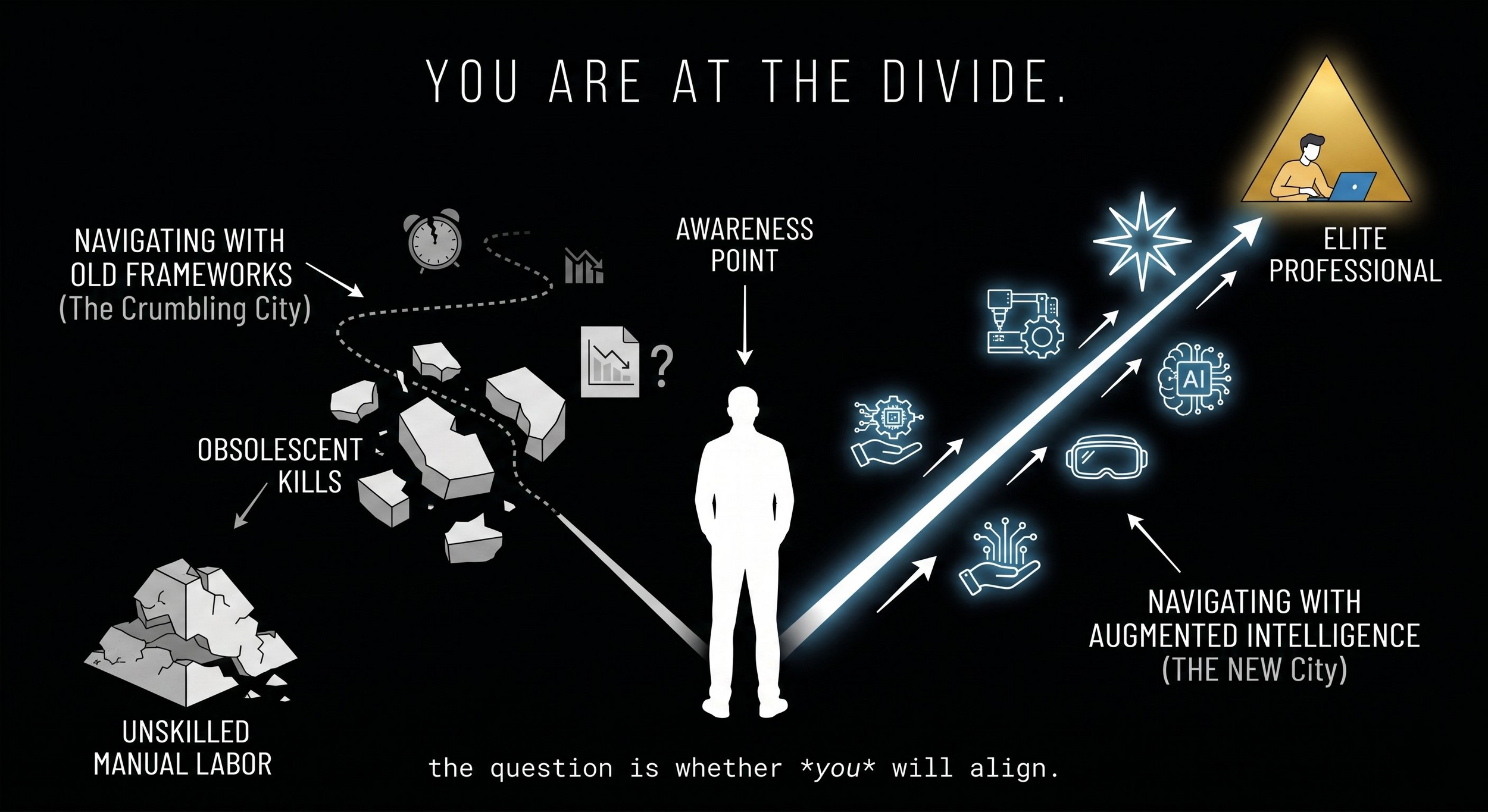
Here is where I leave you.
AI will destroy millions of jobs. That is the truth.
AI will also create millions of new ones. That is also the truth.
The difference between those who get crushed and those who thrive comes down to one thing:
Are you willing to change?
Not tomorrow. Not when it becomes urgent. Now.
The Stoic framework applies here perfectly.
You cannot control the pace of AI development. You cannot control which companies automate. You cannot control government policy or regulation.
But you CAN control what you learn today.
You CAN control how you spend your evenings after work.
You CAN control whether you experiment with new tools or scroll social media for another hour.
Every generation faces a moment where the rules of the game change completely.
The industrial revolution did it. The internet did it. AI is doing it now.
The people who saw the internet coming and learned how to use it created generational wealth.
The people who dismissed it as a fad got left behind.
The same fork in the road is in front of you today.
Choose wisely.
Study deeply.
Stay Stoic.
One clear letter a week. The rules, the math, and the moves. No hype, nothing to sell.